Informační zpráva z mezinárodního civilně-vojenského cvičení ,,CIMEX 2013"
Tomáš NOVÁK
Klíčová slova
Civilně-vojenská spolupráce, Civilně-vojenské cvičení, Mezinárodní konfederace důstojníků v záloze, Centrum Civilně-vojenské spolupráce, CIMIC, CIMEX 2013, CIOR, CCOE
Introduction
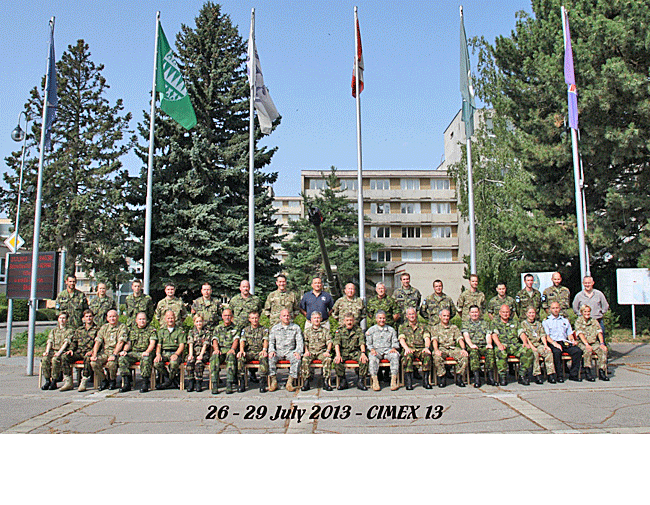
Pic.no.1: The group photo of the participants of the Civil-Military Exercise and seminar 2013 (CIMEX 2013) in Vyškov military facility. (Source: [own])
From the 25th to 29th July Vyškov military facility hosted more than thirty-five reserve officers who attended the Civil-Military Exercise and seminar. The CIMIC exercise, supplemented with CIMIC seminar, was this year a part of the Interallied Confederation of Reserve Officers (CIOR) summer conference which is annually held in a different NATO country.
Background
The flags from the U.K., U.S, Canada, France, Swiss, Denmark, Poland and many others were seen on the uniforms worn by participants. The Czech Republic was represented by regular soldiers from 103rd CIMIC/PSYOPS Centre.
The course of action and timetable of the seminar were prepared and the whole exercise was run by reservists from the U.K. However, the Civil-Military Co-operation Centre of Excellence (CCOE) from the Netherlands, Enschede, has played an indisputable important role as well, since the final scenario of the exercise was prepared in its close co-operation.
The scenario required from the participants a deep understanding of the Crisis Response Operations (CRO) planning process and meeting a few operational demands imposed by fictive operational commander. In order to promote an international co-operation and a mutual understanding, participants were divided into three separate international syndicates.
The main point of the seminar and following exercise were to familiarize participants with CIMIC holistic approach and view to the military contribution to CRO in a respective military operational area. In other words, to utilize the overall knowledge, best practice and personal experience from different places of the world and under different mandates in order to facilitate understanding of CIMIC roles and tools.
Course assembly, day 1
The first day of CIMEX 2013 was devoted to the assembly of the participants in Vyškov military facility. Later on in the evening, the initial briefing and personal administration were organized. Then the participants had a free time to meet each other at the informal Ice Breaker.
CIMIC seminar, day 2
The seminar was opened by remarks which were given by CIMEX 2013 main promoter LtCol. Carroll (U.K). Afterwards, a morning part of planned timetable started. The first subject was Disaster Relief Operations given by Maj. Mike Whatley. His speech was followed by the subject Humanitarian Operations given by LtCol. Martin Browning. The last subject before a lunch break was Contingency Operations, Overview and Considerations; Operational Examples and Post Operational insights given by three speakers; LtCol (Retd) Graeme Olley, LtCol. Andy Hill and LtCol. Martin Browning.
The subject Introduction and Overview of International Organizations (IO´s) and Non-governmental Organizations (NGO´s,) given by an NGO representative and later completed by LtCol. Andy Hill opened the afternoon part of the seminar. LtCol. Andy Hill then continued by his next subject Demobilization, Disarmament, Reintegration (DDR.) The last part was a panel discussion which was mediated by LtCol. Carroll. The panel discussion concluded the first day of the seminar.
CIMIC seminar, day 3
The opening subject Peace Support Operations was in fact the main topic for the whole subsequent day of the seminar. LtCol. (Retd) Graeme Olley, who serves at CCOE and is a subject matter expert, explained his perspective to Peace keeping, Integrated approach, Effectiveness and Accountability and finally Political, Technical and Holistic dimension.
The next subject DPRE(1) Camp Planning Considerations given by Maj. Jay Wienbender was commented from Canadian Tactical and Technical Procedures (TTPs) point of view. Furthermore, Maj. Wienbender integrated into his speech also a possible role of CIMIC unit and Field Force Support Group.
The timetable of seminar continued with the subject Non Combatant Evacuation Operations; Planning Considerations; CIMIC Roles and Tasks given by LtCol. (Retd) Graeme Olley. His speech was based on AJP-3.4.2 Non-Combat Operations.
The last but not least, the DDR subject emerged again as Lt.Col Andy Hill explained in his speech How does DDR relate to other security and peace building priorities (e.g. Security Sector Stabilization, Civil Disarmament, Development and Livelihoods programs). In fact, most of his suggestions originated in a civilian dimension, since a UN(2) brochure UN DDR Guidelines address the issue well.
CIMIC exercise, day 4
The first day of the exercise was devoted to clarify a task which had been given to participants. For this reason a quick overview of previous agenda was organized and the most important points in every subject were highlighted. The task was to suggest to the operational commander feasible solutions for different civilian dimensions.
With reference to the task, the overall security situation as well as humanitarian situation was briefed to the syndicates. Moreover, the syndicates were given UN mandate, variety of humanitarian researches, ROE(3) and respective Operational Order (OPORD) which framed intended military Peace Support Operation.
The syndicates were to focus on Disaster Relief Operation, since according to the scenario a major humanitarian crisis was about to burst. The next significant problem was the volume of automatic rifles among youths. However, the youths were badly organized and did not represent a real threat to the coalition force, they were rampaging streets, stealing from inhabitants and in general destabilizing the overall security situation. Therefore a sound DDR programme was needed.
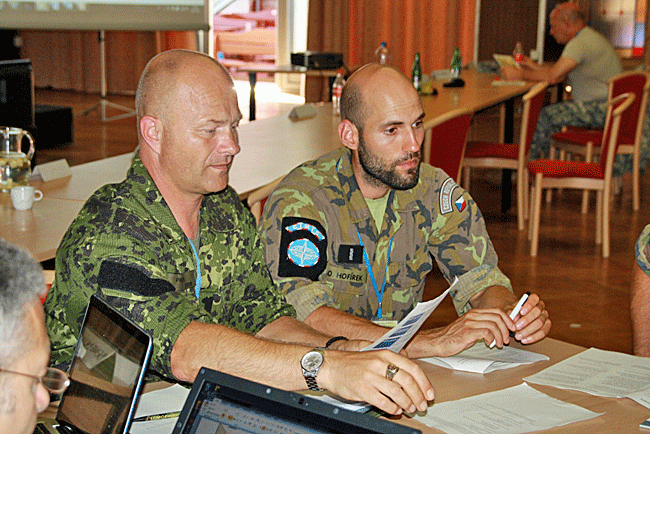
Pic.no.2: An international approach towards solving humanitarian crises and meeting operational demands was promoted by mixture of personnel from different countries in respective syndicate.
The syndicates were to submit an overall CIMIC plan for stabilization operations in two days. Moreover, they were to meet two basic goals. Firstly, the plan should take into consideration the complexity of operational environment. Secondly, the syndicate should brief their plan to the commander in clear and concise manner.
CIMIC exercise, day 5
The last day of the exercise consisted of presentations from all three syndicates to the operational commander. In order to make the situation more realistic, a few respectable guests were invited to represent the operational commander and staff. The regular British Colonel personated the commander and U.S. Colonels personated the staff. The questions which they gave to every syndicate, revealed a plenty of experience related to leading stabilization operations all around the world. As a result, a deeper understanding of the real complexity of operational environment and CIMIC roles within it slowly emerged among all participants once again.
In addition, the Czech Combat Camera Crew (CCC), comprised by members of the Czech PsyOp unit, presented short video clips from the exercise. The video clips should provide participants with an example of being in front of TV camera and answering questions for worldwide TV media services. Every video clip was then observed and positive as well as negative actions and reactions were highlighted.
Conclusions and recommendations
In general, CIOR organization is an international organization with over 1.3 million reservists from NATO and partnering countries. The CIOR´s typical issues of interests include the reserve forces contribution to international operations, re-integration into communities, employer support to reservists etc. However, what make the CIOR organization extremely valuable are the personnel. Actually, many individuals are highly profitable businessmen, dignitaries, officials or academics.
In other words they posses a unique position to contribute to better understanding of security and defence issues in the population. Their civilian expertise and experience could, in particular, refine CIMIC as a military civil-military interaction tool, since they have embraced the needs and objectives of both sides.
Taking all the above mention into consideration, the CIOR summer conference, in terms of CIMEX 2013, was an excellent event and opportunity, since it took things further in many ways.
Firstly, the CIOR organization could act as an international umbrella for our national aspiration to integrate Czech Active Reserve (AZ) into national security and defence concept. In fact, many concerned reservists in the Czech Republic are in AZ. Therefore, the full capable and long lasting CIOR organization could encourage AZ to withstand early deficiency, since the national integration is evolving in a slow and laboured manner. In addition, the existence of organization like CIOR is the evidence that the decision to widely utilize reservists into national security and defence concept was reasonable.
Secondly, the CIMIC basic roles and tools have been adopted among all actors which are concerned, not necessary military, in CIMIC matter, as CCOE had took a lead as a subject matter expert facility. Even though, CCOE provides inputs to the NATO CIMIC documents, from policy down to tactics, techniques and procedures, CCOE is not an organic part of NATO. That provides CCOE with freedom of action even toward entities beyond NATO. Working closely with the CIOR organization as well as with bunch of humanitarian, public well being and academic organizations gives CCOE an opportunity to create a unified platform, from which a common view of CIMIC basic roles and tools evolve.
Finally, international exercises and seminars on CIMIC matters could reassure all participants that a unity of effort and mutual understanding were reached. Moreover, sharing best practice and personal experience from current operations and up-to-date information keep the whole CIMIC family informed. From that point of view, e-learning, Lessons Learned database and Reach-back via the Internet connection were introduced like the outlook for the future, which may preclude a full computer assisted CIMIC training and exercise.
(1) Camps for Internally Displaced Persons (IDP) and refugees (zpět)
(2) The United Nations (zpět)
(3) The Rules Of Engagements (zpět)