Specifický výcvik do misí pro velitele a štáby regionálních velitelství
Jaromír ZŮNA
Klíčová slova
Specifický výcvik do mise, plán výcviku, regionální velitelství, výcvikové cíle, specifické výcvikové cíle, příprava po funkčních oblastech, výcvik v použití informačních systémů pro velení a řízení, přednáška, kulatý stůl, panelová diskuze, media a komunikace, Bílá buňka, mezinárodní organizace, vládní a nevládní organizace, expertní poradce, Afghánské bezpečnostní složky.
Introduction
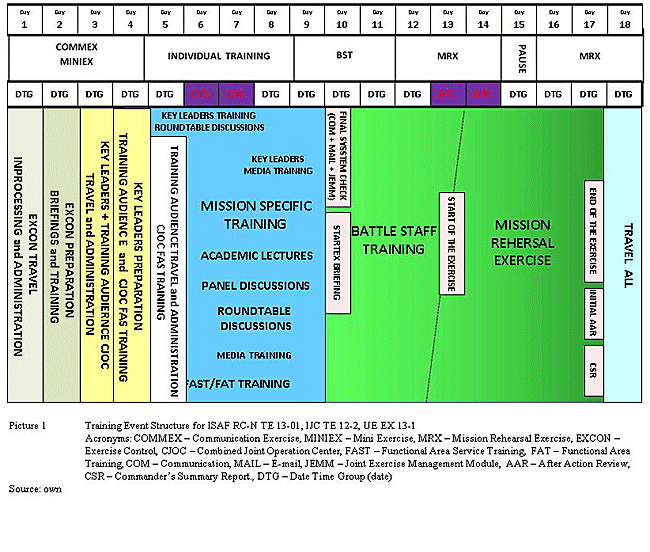
In accordance with the NATO pre-deployment training concept, Phase 2 - NATO Training consists of following parts: Mission Specific Training, Battle Staff Training and Mission Rehearsal Exercise. While Battle Staff Training (BST) and Mission Rehearsal Exercise (MRE) often gain lots of coverage in the military circles, there is usually not that much what external audience can read about the other parts of the training, including the Mission Specific Training (MST). Therefore, it is my intent in this article to share with the readers from the community of educational and training institutions the JFTC´s conceptual approach to the MST. The way how the JFTC organizes the MST for its customers will be explained on the backdrop of the recently organized ISAF Regional Command North Training Event 13-01 (RC-N 13-01), which was conducted at the JFTC in November - December 2012. This methodological approach will enable the future readers to easily translate the doctrinal and conceptual framework which governs the NATO pre-deployment training into practical application of the real life exercise.
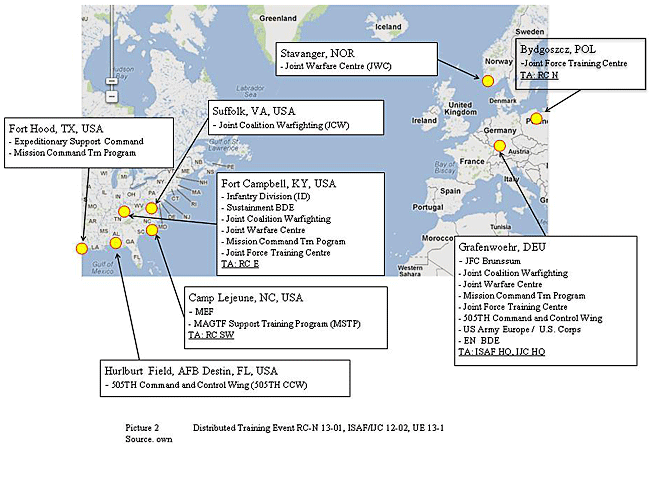
Personnel of the future RC-N HQ, which was trained at the JFTC, mainly derived from the 10th Armored Division HQ (GE). It was further augmented by soldiers from other allied nations participating in the ISAF mission. The overall size of the training audience was 184 personnel, including five flag officers, and commanded by Major General Joerg Vollmer, the future RC-N commander. Additionally, 315 personnel participated in various Exercise Control (EXCON) positions and functions, including four flag officers and 26 representatives of the Afghan National Security Forces (ANSF). The RC-N 13-01 exercise itself was a part of a larger training effort organized by NATO for the ISAF mission, connecting the RC-N 13-01 with the ISAF International Joint Staff Training Event 12-02 (ISAF/IJC 12-02) and U.S. Exercise UNIFIED ENDEAVOUR 13-1 (UE 13-1). By connecting several previously stand alone exercises, in various locations and representing different levels of command, NATO demonstrated a true extent of its capabilities in the management of complex, multilevel, and distributed exercises.
The NATO Bi-SC Exercise Directive 75-3 is generic in nature and, therefore, it is not dwelling much into the details and methodology of the MST. Also, it does not reflect the specific training requirements for ongoing operations, such as ISAF. Among its training responsibilities for the ISAF mission, JFC HQ Brunssum (JFCB) is obliged to provide further training guidance for execution of the pre-deployment training for Regional Command Headquarters (RC HQ), which should be observed by both, the troop contributing nations and NATO training centers. Therefore, in the JFC HQ Brunssum Directive 75-8: COM JFC Brunssum ISAF Training Directive (8 May, 2012), and subsequent training directives and guidance issued by the JFCB, the MST requirements, objectives and structure are more clearly articulated. But, at the end, it is predominantly in the hands of the training institutions and designated future RC commanders how the generic guidance will be translated into a realistic training event.
While recognizing the requirement for commonality and standardization as a modus operandi in the NATO training environment, due to objective reasons, the training institutions may have slightly different approach to the MST. Almost certainly we would not find two NATO or national training centers with an identical design and execution of the MST. Even the text of the JFCB ISAF Training Directive recognizes that a generic guidance always has to be creatively adjusted to the current situation in Afghanistan, differences in operational roles between the RCs and designated RC commanders' training priorities. In each of the training centers the question how the JFCB training guidance is applied depends on countless factors. The governing ones usually include the customer requirements, situation in the area of responsibility of the respective RC, commander's priorities, experience and capabilities of the training centre which supports the exercise, and sources available. Therefore, the final realization of the MST closely mirrors the circumstances and existing conditions in the training institution.
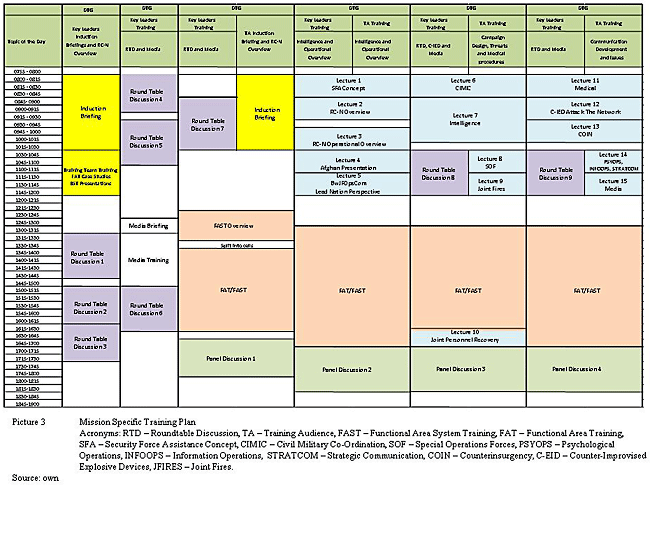
Over the time, the JFTC adopted its own solution and integrated all the training requirements under one umbrella of the MST Training Plan. In order to provide coherent information, this article is based on the structure of the MST currently in use at the JFTC. Although recognizing, that such approach may not be always optimal, but on the other hand, it is the closest reflection of the true sense and purpose of the MST. The JFTC's conception of the MST represents only one variant among many others which are likely to exist in the NATO and national training environments.
Purpose of the Mission Specific Training
Phase 2 - NATO Training aims at preparing the personnel for their mission by providing one-source knowledge, increasing situational awareness and ensuring standardization. In this framework, the purpose of the MST is twofold.
First is the mission's context. The MST provides the conceptual foundation for the knowledge based approach to the mission execution and ability to understand the circumstances in the theatre, which reach beyond the realm of military security, purely military tasks and application of the military force. The MST should, therefore, focus on the themes, which can't be mastered via other forms of training and require in-depth knowledge. It is important to cover especially those areas where the situation is constantly evolving and thus it is necessary to provide the training audience with the most recent information from the theatre. The staff training in general is designed to achieve required level of orchestration among the staff elements and staff members, and to obtain, or retain, common military command and staff competencies. Staff officers often consider the staff training as, although creative, but still, a routine process. The purpose of the MST is to overcome this perception by providing comprehensive information about the mission, its development, realities in the theatre and in such a way adding complexity and depth to the staff training. In order to achieve this aim the Subject Matter Experts (SME), who are supporting the exercise, need to have the most recent, as well as in-depth, knowledge about the situation in the Area of Responsibility (AOR) of the RC HQ that conducts the pre-deployment training.
The second purpose of the MST is to allow the staff members to gain the capacity to understand the related doctrine, operational plans, functional area services, supporting tools and systems, Tactics, Techniques and Procedures (TTPs) and Standing Operating Procedures (SOPs). During the MST the staff members, in their individual and collective functions, will achieve the required level of knowledge, acquirements and habits in order to build capable, confident and cohesive staff teams that support the Commander's decision making process. All these requirements have to be achieved in a relatively short time, by a multinational HQ, where the staff members often see each other for the first time only at the beginning of the training event.
The JFTC is NATO's designated training centre to conduct the RC level training in order to ensure preparation of the commanders and staffs for the ISAF mission in accordance with the NATO standards. In line with this requirement, the RC-N 13-01 training event was designed to meet four standing NATO pre-deployment training objectives, which are:
- Promote continuity and common standards;
- Establish mission awareness in individuals;
- Ensure functional area competence;
- Facilitate staff integration and coordination and exercise the full decision-making process.
To ensure that the members of the RC-N HQ possess the required level of understanding of the current Afghanistan and ISAF mission-related issues the aforementioned overreaching training objectives were further divided into 45 specific training objectives encompassing the following themes: Afghanistan Overview, ISAF Strategy, Regional Command Operations (with emphasis on RC-N), Military Co-Ordination, Civil-Military Co-Ordination (CIMIC), Strategic Communication (STRATCOM) & Information Operations (INFOOPS), and Legal Framework. Specific training objectives are standardized for all RC HQ training and guide the process of preparation and execution of the training event as such. Nevertheless, for any training event these specific training objectives are often adjusted to better reflect the current development in Afghanistan and specific situation in the AOR of the relevant RC. During the course of preparation of the RC-N 13-01 training event the training objectives were discussed with the currently deployed RC-N HQ, BwJFOpsCom, which was the main customer, and designated future RC-N commander. This approach ensured alignment of views among all the participating organizations and also created preconditions for successful execution of the exercise. In the course of the MST, 39 out of 45 specific training objectives had been addressed. This reiterates the importance of the MST among the other parts that made out the RC-N 13-01 training event. A thing to remember - successful completion of the MST and meeting of the specific training objectives should facilitate the training audience's performance in the BST and MRE.
The MST is a continuous process encompassing all the three phases of the NATO Pre-deployment Training - National, NATO Training and the In-theater. During the NATO Training the training audience should further complement the basic knowledge about the ISAF mission developed by the individuals during the national training and obligatory Joint Advanced Distributed Learning (JADL). JADL is a prerequisite for attending any NATO-led ISAF training events. In the case of the RC-N 13-01 the rate of successful completion of the JADL by the training audience was 96%, which is about the standard in training events organized at the JFTC.
The MST like no other part of the training expresses the ideas of the comprehensive approach to the crisis management. Leveraging expertise and knowledge of the civilian actors such as IOs, NGOs, GOs, etc., is crucial for successful execution of the MST. These organizations possess a unique skill-set, experience and in-depth knowledge from the civilian domain which can't be adequately replicated within the military environment. For that reasons the training institutions should have in their disposal formally established functional relationships with civilian actors from mutually supporting/supported organizations. When such a prerequisite exists, then the planning, preparation and execution of the training events becomes easier.
Structure, training methods and content of the Mission Specific Training
For the RC-N 13-01 the JFTC developed the MST Training Plan consisting of two main parts - Functional Area Training (FAT) and Functional Area Service Training (FAST), complemented with the Key Leaders preparation and theoretical preparation. The Roundtable Discussions, Panel Discussions and Academic Lectures represent training methods, which are used astride the confines between individual parts of the training event as well as areas of preparation. These methods may be used, for example, for the Key Leaders and HQ Staff preparation, but equally for the theoretical preparation or FAT. Media Training is a specific training requirement.
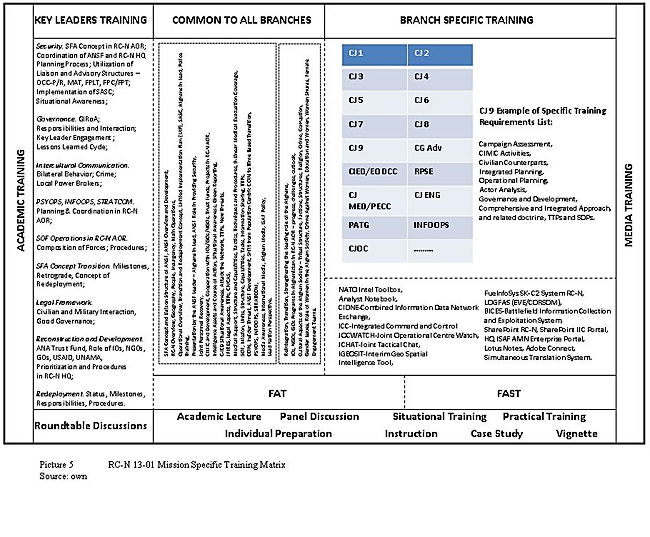
One needs to have a personal experience with the MST in order to understand how it all fits together. All parts of the MST represent an interwoven training process rather than separate steps of the training. Several different activities may support one training requirement. From the organizational point of view for the RC-N 13-01 the MST was organized for the whole training audience (for example the Academic Lectures and Panel Discussions), for the Key Leaders and selected personnel (for example the Roundtable Discussions), and for the staff branches in the following functional areas: CJ1-CJ9, Command Group Advisors, CIED/EODCC, RPSE, CJMED/PECC, CJENG, PATG, INFOOPS and CJOC. Speaking about the FAT/FAST training topics, these were divided into the two main groups - training topics common to all the branches (content of the Panel Discussions, Academic Lectures, Vignette Based Training, etc.) and branch specific training topics (list of topics developed for each branch). Then, the MST can be pictured as a matrix with the following components - the staff structure (Key Leaders, HQ Staff, Staff Branches, even Staff Functions and Processes); the training requirements (ISAF Mission, FAT, FAST, Media Training, categorized as Common to all the branches and Branch specific); and training methods (Roundtable Discussions, Panel Discussions, Academic Lectures, Vignette Based Training, Case Studies, Situational Training, Practical Training using the tools and systems, interactions with the SMEs, facilitators, NCIA instructors, ANSF and the White Cell representatives, video-conferences etc.). In order to facilitate the training process each staff branch (functional area) was supported by a designated subject matter expert and facilitator (person with previous experience from the RC-N HQ in the same functional area). In the RC-N training design the FAT and FAST are strongly connected with frequent intersections. After an initial, theoretical training provided by the NCIA, the staff commences work dedicated to respective staff branches under direct assistance from the SMEs and facilitators. During the FAT the branch members have to deliver an operational overview on how and when to use respective FAS tools in their area of expertise.
The FAT focuses on developing the individual's competency in staff functions and operating procedures in his or her functional area of expertise and may be organized in individual or collective forms of training. The training audience members have to become familiar with the staff practices, TTPs, SOPs, and other requirements associated with their own branch or section within the RC HQ. Information obtained during the academic sessions is further expanded and clarified during the work within the staff branches under the lead of the key leaders and supported by SMEs and facilitators. One of the most effective methods used to trigger the decision making process within the branches is the Case Study.
The FAST is organized for the personnel who require specific functional services skills to perform their functions in the RC HQ. Functional Area Services (FAS) are Software Based Systems that provide support to a specific staff function, process or mission area. In a nutshell, by the FASs we mean command and control support tools and knowledge of related doctrine, TTPs and SOPs used in ISAF. People often think that the overall purpose of the FAS training is to learn how to utilize the systems and became familiar with the hardware and software. In reality, the FAS training deals mainly with the processes which those systems and tools support. The systems may experience failure, or may not always be available, but the military operations and all the processes which support their execution have to be continued. There is a large number of them currently deployed in ISAF. Some of the FASs are purely national assets, while others have been developed for NATO or specifically for the ISAF mission. That is why only those which are requested by the trained RC HQ are included in the training plan.
As mentioned before, the FASs are designed to support the staff functions and expedite the decision making process and staff work in general. In theory, the national phase of the pre-deployment training should bring the RC HQ almost ready to deploy. The reality is obviously different and stems from the nature of multinational operations and a coalition environment. These systems are often not on the inventory of the ISAF troops contributing nations and therefore this training requirement can't be always fulfilled during the national phase of the pre-deployment training. That explains the reason why it is an indispensable part of the Phase 2 -NATO Training. Ability to fully utilize these systems is a prerequisite for occupation of the staff positions, but also, it is precondition for advancement into the next parts of the training, such as the BST/MRE. During the RC-N 13-01 the training audience requested training for the following FASs:
- NATO Intel Toolbox;
- Analyst Notebook;
- CIDNE-Combined Information Data Network Exchange;
- ICC-Integrated Command and Control;
- JOCWATCH-Joint Operational Centre Watch;
- JCHAT-Joint Tactical Chat;
- IGEOSIT-Interim Geo Spatial Intelligence Tool;
- FueInfoSys SK- C2 System RC-N;
- LOGFAS (EVE/CORSOM);
- BICES-Battlefield Information Collection and Exploitation System;
- SharePoint RC-N, SharePoint IJC Portal;
- HQ ISAF AMN Enterprise Portal;
- Lotus Notes, Adobe Connect, Simultaneous Translation System.
The staff personnel are trained for utilization of the FASs at the user level. The JFTC possess only limited internal expertise to provide such training. Therefore it contracts trainers from the NATO Communication and Information Agency (NCIA) and receives training support from the NCIA Service Operations Squadron Bydgoszcz, which is collocated with the JFTC. The training is very practical, using real systems and tools. By the end of the FAST portion of the MST, all the personnel have to be competent in utilization of their assigned functional services applications and comfortable in working as branch members of the RC HQ. One thing is to master the requirements individually in the class environment. The other is practical demonstration of the expertise during the BST/MRE when the trainees are encountering nearly real situations and have to work under the duress of the situational development driven by the exercise scenario. It is common practice that even during the BST/MRE parts of the training the SMEs, contractors and facilitators have to provide additional assistance to the staff members.
The Roundtable Discussion is the main method for preparation of the commanders and other Key Leaders. The purpose of the roundtable discussions is to elevate the level of detail and depth of knowledge about specific topics, which have been identified as mission critical. Because the focus is on the specific part of the RC HQ, from methodological viewpoint, it could be also considered as a part of the FAT. Nevertheless, as I said earlier, the application of this method may not be limited just to the RC HQ command group. It is under designated commander's discretion what part of his staff will be included in the discussions and for which topics. The commander can make individual roundtable discussions strictly focused on the particular functional area, or, on the other hand, make it almost common to all. For example, we had the case when the main topic was covering SOF. The commander decided to include in this roundtable discussion only the personnel involved in SOF operations. But another example, when the topic of the roundtable discussion was dedicated to CIVCAS, the commander required participation of almost the whole staff. The roundtable discussions represent controlled discussion chaired by the designated future RC commander, who also determines the scope of participation from his staff. Usually they are the deputies, chief of staff, all key leaders down to the level of a branch head and those who are responsible for management of independent functional areas. The roundtable discussions are supported by a moderator, lecturers, SMEs, White Cell Members, representatives from the RC HQ currently deployed in Afghanistan and ANSF members. Also, each session is attended by a member of the analysis and lessons learned section to capture the main outcomes, observations and guidance from the RC commander. For the RC-N 13-01 training event the following topics have been discussed during the roundtable discussions:
- Security. Implementation of SFA Concept in RC-N AOR; Coordination and Integration of ANSF and RC-N HQ Planning Process; Utilization of Liaison and Advisory Structures - OCC-P/R, Military Advisory Team (MAT), Forward Planning and Liaison Team (FPLT), Force Protection Cell/Force Protection Team (FPC/FPT); Implementation of Situational Awareness and Security Concept (SASC); Situational Awareness;
- Governance. Government of the Islamic Republic of Afghanistan (GIRoA) Responsibilities and Interaction; Key Leader Engagement - Prioritization, Responsibilities, Planning, Lessons Learned Cycle;
- Intercultural Communication. Bilateral Behavior; Crime; Local Power Brokers;
- PSYOPS, INFOOPS, STRATCOM. Planning and Coordination in RC-N AOR;
- SOF Operations in RC-N AOR. Composition of Forces, Procedures;
- SFA Concept Transition. Milestones, Retrograde, Concept of Redeployment;
- Legal Framework. Civilian and Military Interaction, Good Governance;
- Reconstruction and Development. ANA Trust Fund, Role of International Organizations (IOs), Non-Governmental Organizations (NGOs), Governmental Organizations (GOs), USAID, UNAMA, Troops Contributing Nations, Prioritization and Procedures in RC-N HQ;
- Redeployment. Current Status, Milestones, Responsibilities, Procedures.
One of the responsibilities of the RC commanders is to prioritize the value of individual topics in terms of their importance for the mission. Based on their observations, they may decide during the exercise to put forward requirements to adjust the time allocated to individual topics. They may also require scheduling of additional round table discussions if they come to the conclusion that it is necessary for the proper preparation of their staff. Having more than two roundtable discussions per day is physically demanding for the facilitators and attendees. Therefore, the number of these discussions scheduled for one day should be kept within manageable limit.
The roundtable discussions usually start with the introduction of the topic by the moderator and presentation of the key themes for the discussion. Sometimes, several topics may be scheduled for one session. After the introduction, a lecture follows, which is given by an SME. It proved to be useful if, after the opening lecture, the RC commander presents his personal view on the subject, followed by the comments from his deputies, which in turn opens additional topics for discussion. The discussion should serve as a venue during which the staff gains deeper understanding of the subject matter, gets better understanding of the commander's intent, contributes to the orchestration of the staff and understanding of the mission, improves knowledge about the SOPs/TTPs and their application for that specific area, fosters internal communication and facilitates the flow of information among the members of the international RC HQ.
The Academic Lectures are designed for the whole training audience including the Key Leaders. They are more generic and academic in nature than the roundtable discussion. Overall purpose of the academic lectures is to increase the level of understanding of the mission context. For the RC-N 13-01 Training Event the following lectures have been prepared:
- SFA Concept and Liaison Structure of ANSF, ANSF Overview and Development;
- RC-N Overview, Geography, People, Insurgency, Main Operations;
- Operational Overview, Transition and Redeployment Concept, Unified Implementation Plan (UIP), SASC, Afghans in Lead, Police Training;
- Presentation by the ANSF Leader - Afghans in Lead, ANSF Role in Providing Security;
- Joint Personnel Recovery;
- CIMIC and Development, Cooperation with IOs/GOs/NGOs, Trust Funds, Projects in RC-N AOR;
- Intelligence Assets and Course of Action, Situational Awareness, Green Reporting;
- C-IED Situational Awareness, Attack the Network, TTPs, New Threats;
- JFIRES, Legal Aspects, TTPs, CIVCAS;
- Medical Support, Structure and Capabilities, Tactics, Techniques and Procedures, 9-Linear Medical Evacuation Coverage;
- SOF, Mission, Units, Structure, Capabilities, Tasks, Information Sharing, TTPs;
- COIN, Insider Threat, ANSF Development, Shift from Population Centric COIN to Time Based Transition;
- PSYOPS, INFOOPS, STRATCOM;
- Media Awareness, International Media, Afghan Media, ISAF Policy;
- Lead Nation Perspective.
Composition of the topics was driven by the situation in the theatre, evolution of the mission, recommendations from the currently deployed RC-N HQ in Afghanistan and requirements of the BwJFOpsCom. The content of the lectures was discussed with the briefers before the training event. During the EXCON preparation it is always necessary to align the content of the lectures and inform the briefers of the methodology, technical and material support which is available at the JFTC. The lecturers usually come from different institutions, or commands, and have a different level of practical experience with lecturing. Then, the MST manager from the JFTC has to ensure:
- An in-depth explanation and coordination with the SMEs and facilitators;
- There are no redundancies or overlaps between the content of the JADL and MST, which have to be validated by the BwJFOpsCOM;
- The content of the lectures supports the training objectives, avoids repetition and outdated topics;
- The briefings observe standard format slides, such as introduction, agenda, training objectives, classification, etc.;
- Each lecture, which will be introduced to the training audience, observe planned breaks and avoid that the lecture goes longer that the scheduled time;
- There is a logical flow of information in the lectures and no overlap or collision of the content.
These requirements apply to all the parts of the MST. Since many of the external EXCON members already have previous experience from training organized at the JFTC the quality of the presentations is steadily increasing as well as the ability of the briefers to deliver high quality lectures. The lecturers are responsible for the selection and application of the training methods and methodical turns which are the most suitable/effective for the topic and achievement of the specific training objectives.
The Panel Discussions are an additional type of venue which further expands the information obtained during the JADL and academic lectures. The focus of panel discussions is on the context by grouping individual topics into coherent themes which constitute the backbone of the current phase of the ISAF mission. Panel discussions help emphasize the complexity of the operational environment by showcasing multiple perspectives on different topics, such as the UN, IOs, GOs and NGOs programs in Afghanistan. For the RC-N 13-01 training event the BwJFOpsCom requested panel discussions about following themes:
- Reintegration, Transition, Strengthening the Leading role of the Afghans;
- IOs, NGOs, GOs Programs in Afghanistan in RC-N AOR - progress, challenges, outlook;
- Cultural Aspects of the Afghan Society - Tribal Structure, Factions, Structures, Religion, Crime, Corruption;
- Gender Issues, Role of Women in the Afghan Society, Crime against Women, Education and Women, Women Shuras, Female Engagement Teams.
The panel discussions are facilitated by the MST manager, designated moderator and necessary technical support. The panelists consist of the SMEs, White Cell members, and ANSF representatives, depending on the topic. When the panelists do not possess sufficient command of English, translation may be required. Panel discussions usually start with a brief introduction to the theme and the participating panelists, followed by presentations given by the panelists. The content of the panel discussions may be enriched by a wide range of instructional tools such as the documentary/training movie, video conference, practical demonstrations, visual materials etc., in order to attract the training audience´s attention to the topic and ensuring clarity of the information. The main part of the panel discussion is the Questions & Answers session (Q&A) for which the bulk of time should be allocated. Based on our experience, the duration of the sessions should not exceed one and a half hour. Panel experts or practitioners should have different opinions on the topic. Another important point also is to network with the personnel who will be on the panel several weeks in advance to synchronize materials and allow them to put their thoughts together in order to produce coherent presentations.
The purpose of the Media Training is to inform about the role of media and importance of strategic communications within the ISAF mission; to teach about NATO policies and SOPs directing the ISAF information operations, media relations and local media in Afghanistan; and to train the Key Leaders and the staff in skilful planning, coordination and execution of strategic communications and media related tasks. All in all, the purpose of media training is to train the RC HQ in how to turn the media from an obstacle to an advantage. Thus, the MST should create sufficient knowledge base for the staff and the Key Leaders to be able to practically solve the scenario situations which will be included in the BST and especially the MRE. During the MST, six and a half hours of media training have been devoted for the Key Leader Training and additional two hours for the whole training audience. All the Key Leaders were trained on the procedures for delivering appropriate interviews to the mass media (TV, radio broadcasting, print journalism and the internet). Theoretical parts were covered during the roundtable discussions. The training audience received comprehensive overview in two lectures, followed by discussions with experts about the role and function of the international, national and local media in Afghanistan and the northern region. For the execution of media training the JFTC contracted the Crown Media Company which specializes in pre-deployment training of individual military personnel and the staffs. During the RC-N 13-01 training event the Crown Media was used to conduct lectures, roundtable discussions, practical training for Key Leaders in conduct of the interviews for various media, played the roles of international and local media (TV, radio, internet), filmed training movie for the RC-N HQ and provided its own technical support.
Video-conferences with the ISAF IJC HQ and RC-N HQ were used during the MST for the update of the SMEs about the current development in the theatre and also for the Q&A sessions. Role playing and situational training were included especially in the media training, but were also used during the lectures. Despite the fact that the MST training is to a large extent theoretical in nature, there is a need to include practical training in order to develop required knowledge, acquirements and habits among the members of the training audience. Role playing and situational training naturally extend to the BST/MRE when the content of the MST merges with the other parts of the RC HQ training in a holistic manner.
Organization of the Mission Specific Training
The organization of the MST and the scope of its support are driven by several factors. The training objectives are the most important as they represent qualitative requirements that have to be met. Second is the exercise budget, which governs the quantitative confines within which the whole training event is organized. Remaining factors may vary and they are both: external - related to the mission, training audience and training requirements; and internal - referring to the capabilities of the training institution. The first may include the type of the exercise, size of the training audience, composition of the Staff/HQ which is trained (national/multinational), its level of experience, mission context, etc. The latter may reflect the level of experience of the staff, technical and material competence and others. The JFTC, over the years of systematic buildup and involvement in the pre-deployment training, has already accumulated a significant amount of experience, reputation and expertise which, combined with an impressive technical capabilities, make this place well suited for execution of the MST and meeting its both major prerequisites - quality of training for a favorable price.
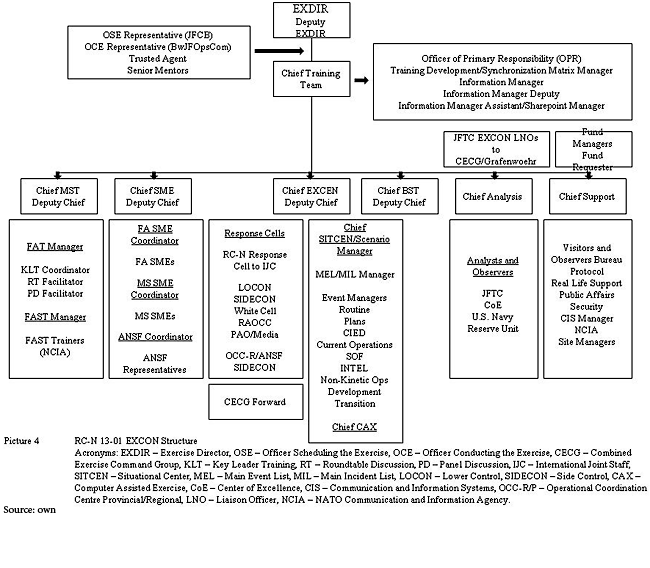
Basic precondition for successful execution of the MST is availability of the right composition of personnel for the management and support of the MST. During the RC-N 13-01 Training Event the EXCON was running the MST through the Chief MST and his section. The Chief MST carries out complex duties, usually covering planning, preparation, coordination and execution of the MST. That includes development of the MST Training Plan, alignment of the content of the FAT, FAST, Academic Lectures, Panel Discussions and Roundtable Discussions, arrangements for participation of the external experts, coordination of the material support, planning for availability of the training space and facilities, personnel support, establishment of the command and control structure and management plan and the development and management of the MST budget. He closely coordinates his tasks with the Chief SME section, who directs the SMEs´ support during the course of the exercise. Besides the JFTC staff and the JFTC Support Unit components, the supporting elements for the MST consisted of the White Cell, ANSF personnel, U.S. Navy Reserve Support Unit and already mentioned SMEs, facilitators and the Crown Media.
The White Cell typically represents agencies, organizations, institutions and individuals outside of the NATO and opposing forces structure. The composition of the White Cell may include local governments at national, provincial and municipal levels, IOs, GOs, NGOs, international and local media, local civilians and country experts. For the RC-N 13-01 training event following organizations have been represented in the White Cell:
- United Nations High Commissioner for Refugees (UNHCR);
- International Committee of the Red Cross (ICRC);
- German Federal Ministry for Economic Cooperation and Development (BMZ);
- German General Consul to Poland;
- United Nations Office for Coordination of Humanitarian Assistance (UNOCHA);
- United States Agency for International Development (USAID);
- Afghan Drugs & Justice Unit, Foreign and Commonwealth Office;
- United Nations Office for Drugs and Crime;
- United Nations Assistance Mission to Afghanistan (UNAMA);
- Afghanistan Country Experts.
Their main role was to prepare and deliver the MST lectures for the training audience, but also to act as specialists and advisors to the training audience throughout the exercise. Also, members of the White Cell were involved in the MEL/MIL scripting and coordination of the BST/MRE with the event managers.
Participation of the ANSF personnel traditionally belongs to the highlights of the training organized by the JFTC. A lot has already been said about the value which the ANSF representatives bring to the exercises. The RC-N 13-01 Training Event was supported by 26 ANSF members, including the flag officers. The group composed of 5 members of the Afghan National Army (ANA), 11 policemen from the Afghan National Police (ANP) and 10 interpreters. Over the years the JFTC managed to reach full coordination with the ANSF with regards to selection of the right personnel for training events in Bydgoszcz. The ANSF personnel are nominated from the same units (regions) with which the training audience will be cooperating after the deployment. That creates favorable conditions for establishment of personal contacts and reinforcement of mutual understanding between the ANSF and the RC-N HQ staff members. Both are the indispensable qualities for successful execution of the ISAF mission.
U.S. Navy Reserve Support Unit (Norfolk) is not a very visible element of the EXCON structure, but its support is highly valued by both the JFTC and the training audience. The unit is officially designated as a support unit for the ACT. As such, on request, it also may support the training events organized at the JFTC. Since the JFTC staff is fairly limited, the unit is an additional source of personnel for a variety of functions within the EXCON. They possess the expertise, organizational skills and are already familiar with the JFTC and its staff and capabilities. Therefore it is relatively easy to integrate them into the EXCON structure. Tasks performed by its members span across all the parts of the MST. They are involved in the preparation and organization of the sessions, assist the SMEs in the preparation of the lectures, act as the site managers, moderators and facilitators during the roundtable and panel discussions, organize technical support for the MST and participate in the lessons-learned process.
Conclusion
When looking into the post-ISAF period, NATO will shift its training effort from a campaign to a contingency posture. That will also change the context of NATO exercises. But still, there are strong indications that the requirement for the MST will remain and its role is not going to diminish. The assumption is based on several factors. The most important one is that NATO training for the current operations remains among its top priorities. The ISAF will be replaced by the NATO International Training Advisory and Assistance Mission (AITAAM) for which the new training concept and specification for the NATO Pre-deployment Training will be required. The character of the ITAAM mission means that the MAT/PAT mission will, for the foreseeable future, endure. Like in all the previous NATO pre-deployment training the MST will again constitute its crucial part in order to deliver mission specific training requirements.
For the multinational HQs there will always be the need for the FAT/FAST in order to gain the required level of expertise in related doctrine, SOPs, TTPs and C2 supporting tools and services. That applies equally for the multinational HQ, which is going to be deployed in the current operation, as well as for the one trained for the NATO Response Force (NRF). Also, the comprehensive approach is becoming the common framework for the potential future contingency operations. In this context the participation of the partners in the future NATO exercises will become a norm. These predictions further reinforce the need for having the MST part included in the future NATO training concept. The content and scope of the MST in the future exercises may differ depending on the type, complexity and level of the exercise. For example, there will probably be the differences between the training organized for the HQs from the NATO Command Structure and NATO Force Structure. Each HQ may have different level of experience and may be functioning in different conditions. But still, the purpose of the MST will remain the same. That is why NATO training institutions will have to stay abreast of the development and be ready for their future roles.
Experience from the ISAF Pre-deployment Training proves that, in principle, the design of the MST, which is currently used in NATO, is well suited for training of multinational HQs. The structure of the MST enables full integration of the partners and civilian actors into the training and effective/efficient utilization of the capabilities which exist in the NATO training institutions. It is also flexible enough to accommodate any specific future requirements which may arise from the NRF training.
Literature
[1] JFC HQ Brunssum Directive 75-8: COM JFC Brunssum ISAF Training Directive. NATO JFCHQ Europe. BD J6/243/2012 127. 8 May 2012.
[2] Bi-SC Exercise Directive 75-3. NATO SAC Europe. SA J7/TEX/GA/08-205 368. 23 October 2008.